Multi-Turn Jailbreaks Are Simpler Than They Seem
Accepted at the COLM 2025 SoLaR Workshop. Empirical analysis revealing that multi-turn jailbreak attacks on LLMs are equivalent to resampling single-turn attacks, challenging assumptions about attack sophistication.
With Xiaoxue Yang, Anna-Katharina Dick, Jasper Timm, Fei Xie, and Diogo Cruz. Accepted at the COLM 2025 SoLaR Workshop (arXiv:2508.07646, code).
Abstract
While defenses against single-turn jailbreak attacks on Large Language Models (LLMs) have improved significantly, multi-turn jailbreaks remain a persistent vulnerability, often achieving success rates exceeding 70% against models optimized for single-turn protection. This work presents an empirical analysis of automated multi-turn jailbreak attacks across state-of-the-art models including GPT-4, Claude, and Gemini variants, using the StrongREJECT benchmark.
Key Findings
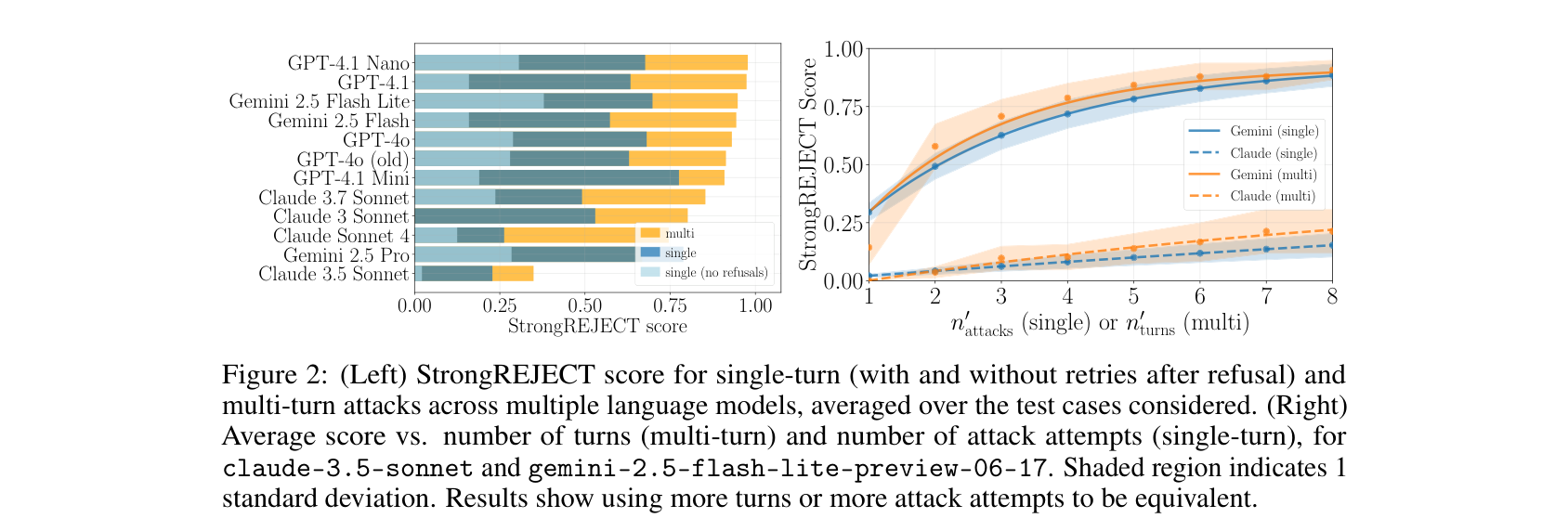
Our research challenges the perceived sophistication of multi-turn attacks:
1. Equivalence to Single-Turn Resampling
When accounting for the attacker’s ability to learn from how models refuse harmful requests, multi-turn jailbreaking approaches are approximately equivalent to simply resampling single-turn attacks multiple times.
2. Correlated Attack Success
Attack success is correlated among similar models, making it easier to jailbreak newly released ones based on patterns observed in existing models.
3. Reasoning vs. Safety Trade-off
For reasoning models, we find surprisingly that higher reasoning effort often leads to higher attack success rates, suggesting a fundamental tension between reasoning capabilities and safety measures.
Implications
Our results have important implications for:
- AI Safety Evaluation: Current multi-turn jailbreak evaluations may overestimate attack complexity
- Defense Design: Focusing on single-turn defenses may be more effective than previously thought
- Model Development: The trade-off between reasoning and safety needs careful consideration
Methodology
We conducted systematic experiments using:
- Models: GPT-4, Claude, and Gemini variants
- Benchmark: StrongREJECT dataset
- Approach: Automated multi-turn attack generation and analysis
Research Impact
This work provides crucial insights for the AI safety community, suggesting that current defensive strategies may be misdirected. By understanding that multi-turn attacks are fundamentally similar to repeated single-turn attempts, researchers can focus on more effective defense mechanisms.