Discovering Hidden Algebraic Structures via Transformers with Rank-Aware Beam GRPO
Published in TMLR. A novel approach to multivariate polynomial decomposition using transformers and rank-aware reinforcement learning, achieving 75% reduction in inference compute.
With Gio Huh, Ning Su, and Tony Yue Yu. Published in Transactions on Machine Learning Research (TMLR) (arXiv:2508.15766, OpenReview, code).
Abstract
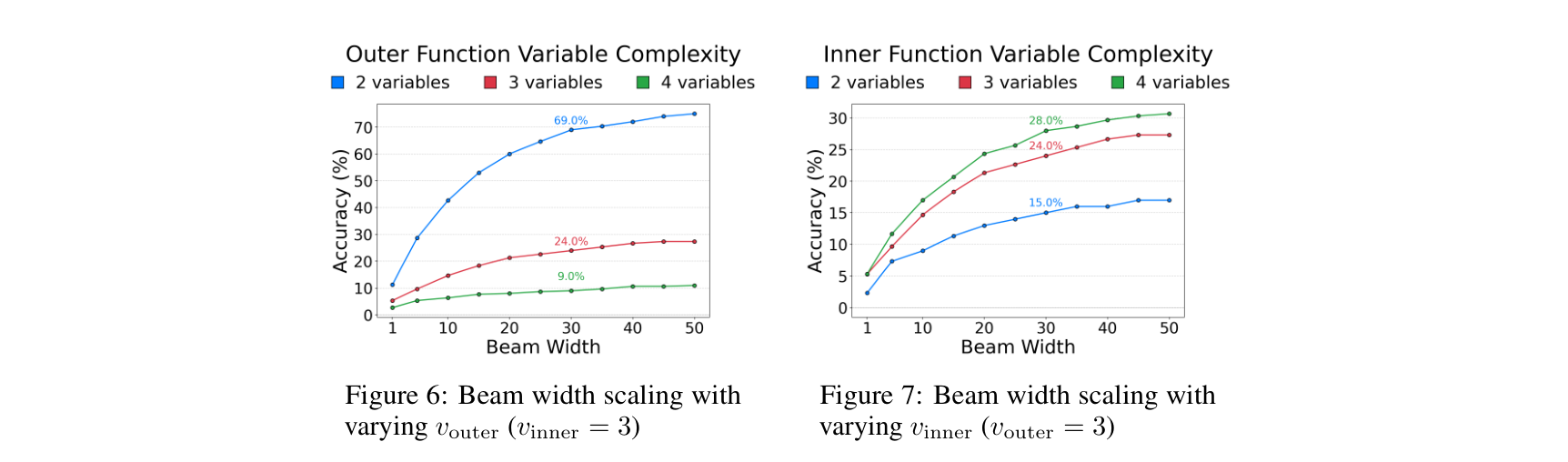
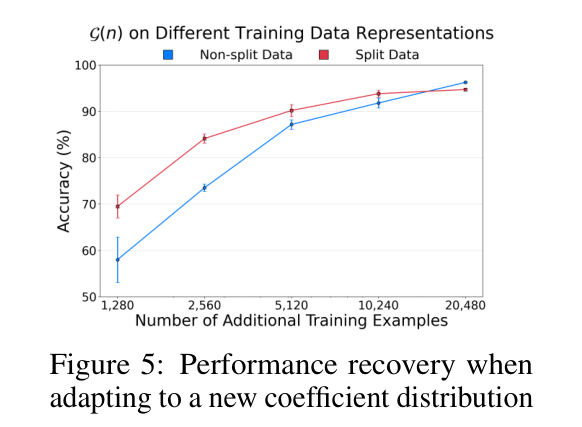
We study the capabilities of small-scale transformer models in symbolic reasoning, focusing on the NP-hard algebraic task of multivariate polynomial decomposition, with widespread applications in science and engineering. Our approach includes a fine-grained synthetic data generation pipeline, supervised pretraining, beam search, evaluations for scaling behavior and generalizability, and a novel rank-aware reinforcement learning method called Beam Grouped Relative Policy Optimization (BGRPO), which improves accuracy while reducing inference compute by up to 75%.
Key Contributions
1. Novel BGRPO Algorithm
We introduce Beam Grouped Relative Policy Optimization (BGRPO), a rank-aware reinforcement learning method that:
- Improves decomposition accuracy
- Reduces inference compute by up to 75%
- Handles the sparse solution space of polynomial decomposition
2. Synthetic Data Pipeline
Our fine-grained synthetic data generation pipeline enables:
- Systematic training on polynomial decomposition tasks
- Controlled complexity scaling
- Comprehensive evaluation across difficulty levels
3. Competitive Performance
Our transformer-based model demonstrates:
- Competitive performance with traditional symbolic systems
- Outperforms Mathematica in various polynomial simplification cases
- Strong generalization across different polynomial structures
Technical Approach
Problem Definition
Functional decomposition poses significant challenges because:
- Sub-functions can be completely hidden in the final compact form
- Requires extreme precision with no margin of error
- Admits only a sparse set of correct solutions
Methodology
- Supervised Pretraining: Train transformers on synthetic polynomial data
- Beam Search: Explore multiple decomposition candidates
- BGRPO: Rank-aware reinforcement learning for optimization
- Evaluation: Scaling behavior and generalizability analysis
Research Impact
This work demonstrates that transformers can:
- Discover hidden patterns in mathematical structures
- Compete with traditional symbolic systems in specialized domains
- Benefit from novel RL approaches tailored to symbolic reasoning
Applications
- Scientific computing and engineering
- Computer algebra systems
- Automated theorem proving
- Mathematical discovery
Collaboration
Authors: Jaeha Lee, Gio Huh, Ning Su, Tony Yue Tu
This research represents a significant step forward in applying deep learning to symbolic mathematics, showing that transformers can excel in domains requiring precise symbolic manipulation.