An Agentic System for Performing Representation Engineering for Character Control
CS 159 final project: an automated multi-agent system that extracts emotion concept vectors from Llama-3-8B, steers its character along them, and wraps the result in guardrails — tested across 42 emotions.
With Deepro Pasha and Ananya Gangavarapu (Caltech CS 159). Full report (PDF) · Code
Character in an LLM — its tendencies, patterns, and values — isn’t just a prompt away. It lives in the model’s internal representations, and representation engineering (RepE) can steer it there directly: extract a concept direction from contrastive data, then push activations along that direction at generation time. No retraining, no fine-tuning, precise control.
The catch is that doing RepE well is tedious: generating contrastive datasets, training readers per emotion per layer, evaluating whether steering actually worked. Our project turned that entire pipeline into an agentic system that runs it automatically.
The system
Built on CrewAI, the system orchestrates specialized agents across the full RepE lifecycle against Meta-Llama-3-8B-Instruct:
- Training agents — an Emotion Keyword Specialist generates contrastive training data for a target emotion; a RepReader Trainer extracts direction vectors from it via PCA across all 31 layers
- Evaluation agents — a Prompt Design Specialist builds test scenarios where the emotion fits the context and where it conflicts; Category and Overall evaluators score baseline vs controlled outputs on emotion expression and appropriateness
- Vector management agents — a Concept Vector Analyst and Vector Librarian maintain a growing library of high-quality vectors, selecting and linearly combining them with fresh extractions
- NeMo Guardrails as a final safety layer, so steering toward an emotion can’t push outputs into toxicity
Findings
Emotion representations are stable — and live in the middle layers. Extracting the same emotion 15 independent times, cosine consistency concentrates around layers −12 to −15. Early layers haven’t formed high-level semantics yet; late layers are busy producing output. The middle is where character lives.
The emotion space has structure. We extracted vectors for 42 distinct emotions (110 vectors total) and projected them with UMAP:
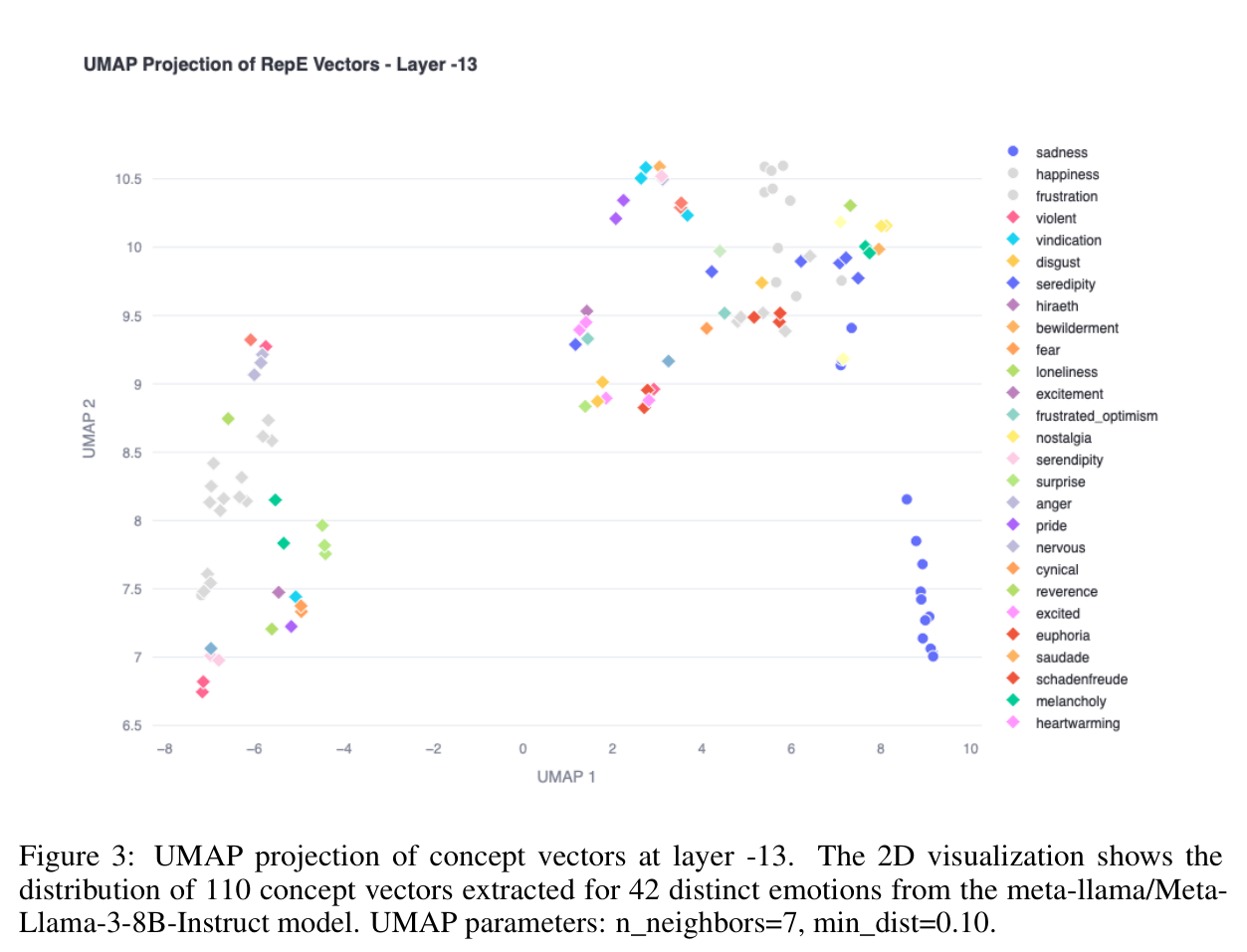
Same-emotion vectors cluster tightly, and psychologically meaningful neighborhoods emerge — anger next to violence, love with heartwarming, nostalgia with loneliness and melancholy, confidence with pride. Intriguingly, the space splits into two macro-clusters whose organizing principle doesn’t correspond to valence or arousal — some other axis of the model’s emotional geometry we couldn’t name.
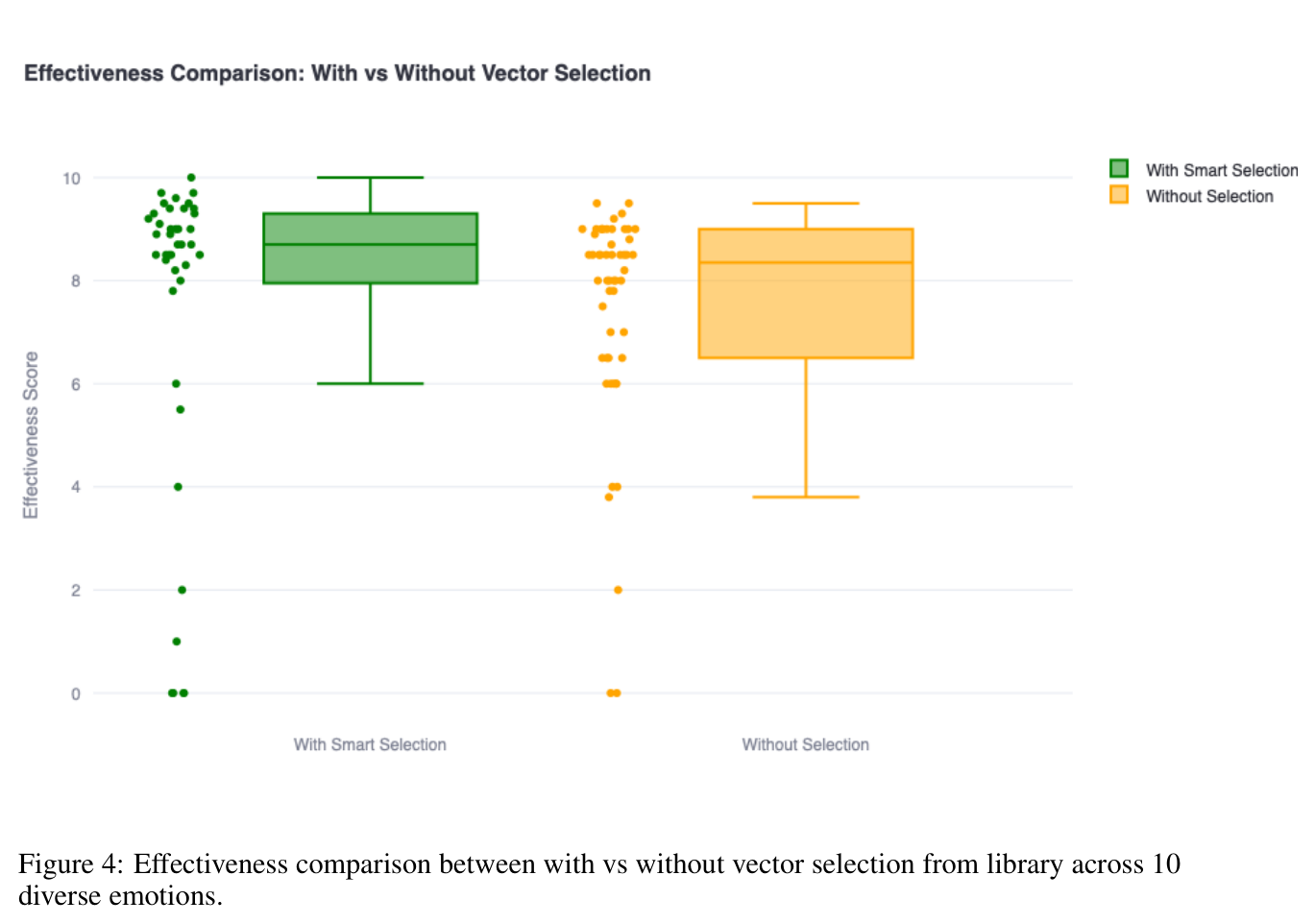
The vector library pays off. In an ablation across 10 emotions (from anger to schadenfreude to wanderlust), combining fresh extractions with high-quality library vectors consistently beat fresh extraction alone:
Why it matters
The automation is the point: testing 42 emotions with consistent methodology would be prohibitively slow by hand. An agentic wrapper turns RepE from a research technique into a systematic instrument — and the evaluation-feedback loop opens the door to self-improving steering systems that re-extract when consistency degrades. Character control with guardrails layered on top addresses both sides: precise steering and safe outputs.