Exploring the Holographic Entropy Cone via Reinforcement Learning
Published in JHEP (2026). We develop a reinforcement learning algorithm that searches for graph realizations of entropy vectors, resolving the status of “mystery” extreme rays of the N=6 holographic entropy cone and revealing that unknown holographic entropy inequalities must exist.
With Temple He and Hirosi Ooguri. Published in JHEP 06 (2026) 267 (arXiv:2601.19979).
Overview
The holographic entropy cone (HEC) characterizes which entanglement entropy patterns are achievable in holographic quantum systems. Determining whether a given entropy vector lies inside the cone is a hard combinatorial problem: a vector is holographic if and only if it admits a graph realization whose min-cut entropies match the vector.
We developed a reinforcement learning algorithm that searches this space of graph realizations directly. Given a target entropy vector, the agent modifies a weighted graph to match the target’s min-cut structure, with reward given by the cosine similarity between the achieved and target entropy vectors.
The algorithm as a probe
Two regimes make the method useful:
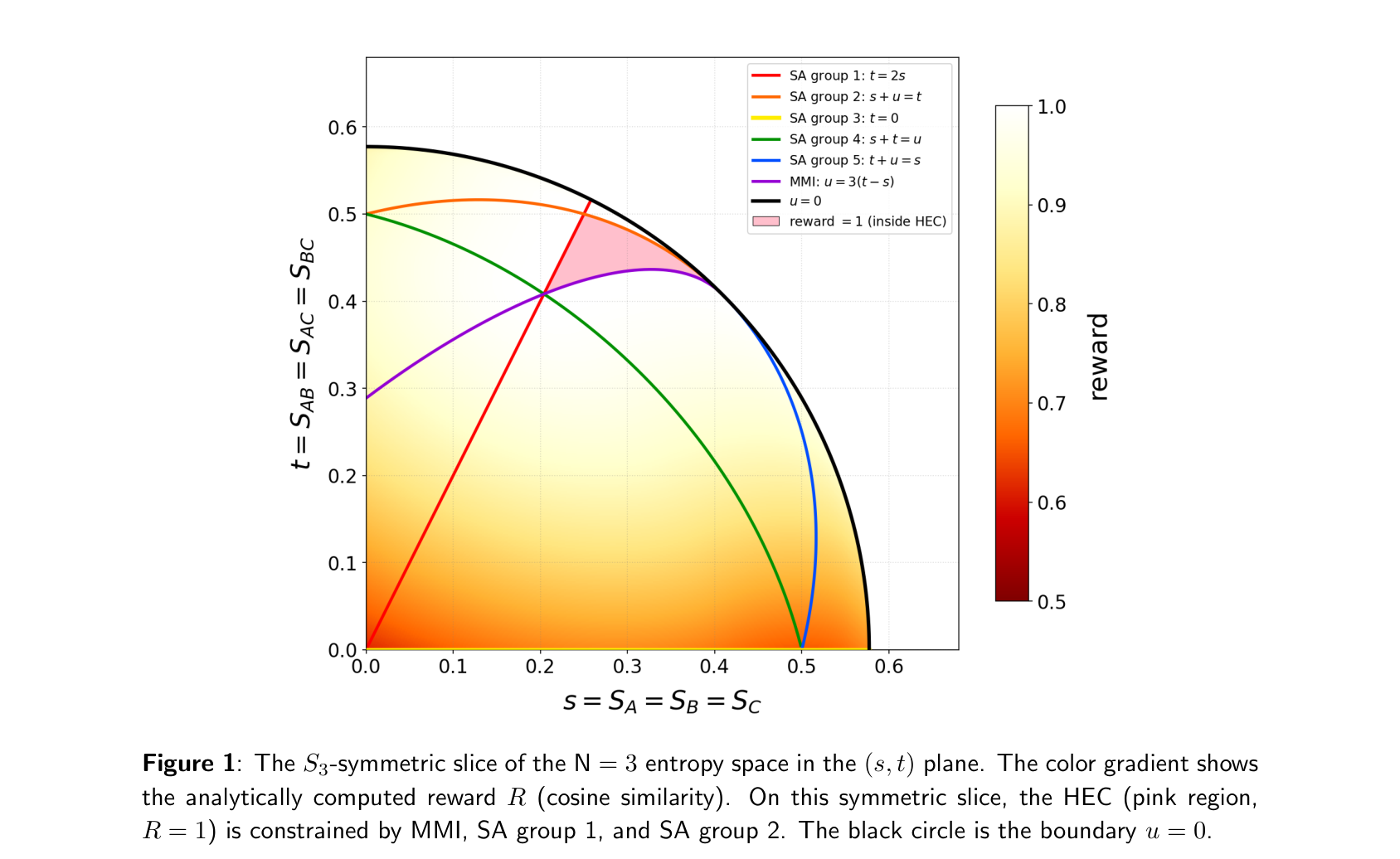
- Classification — if the agent reaches reward 1, the target vector admits a graph realization and lies inside the HEC.
- Navigation — if the target is outside the cone, the agent converges to the nearest realizable vector, and the reward gradient points toward the cone’s boundary — probing the location of unknown facets.
Results
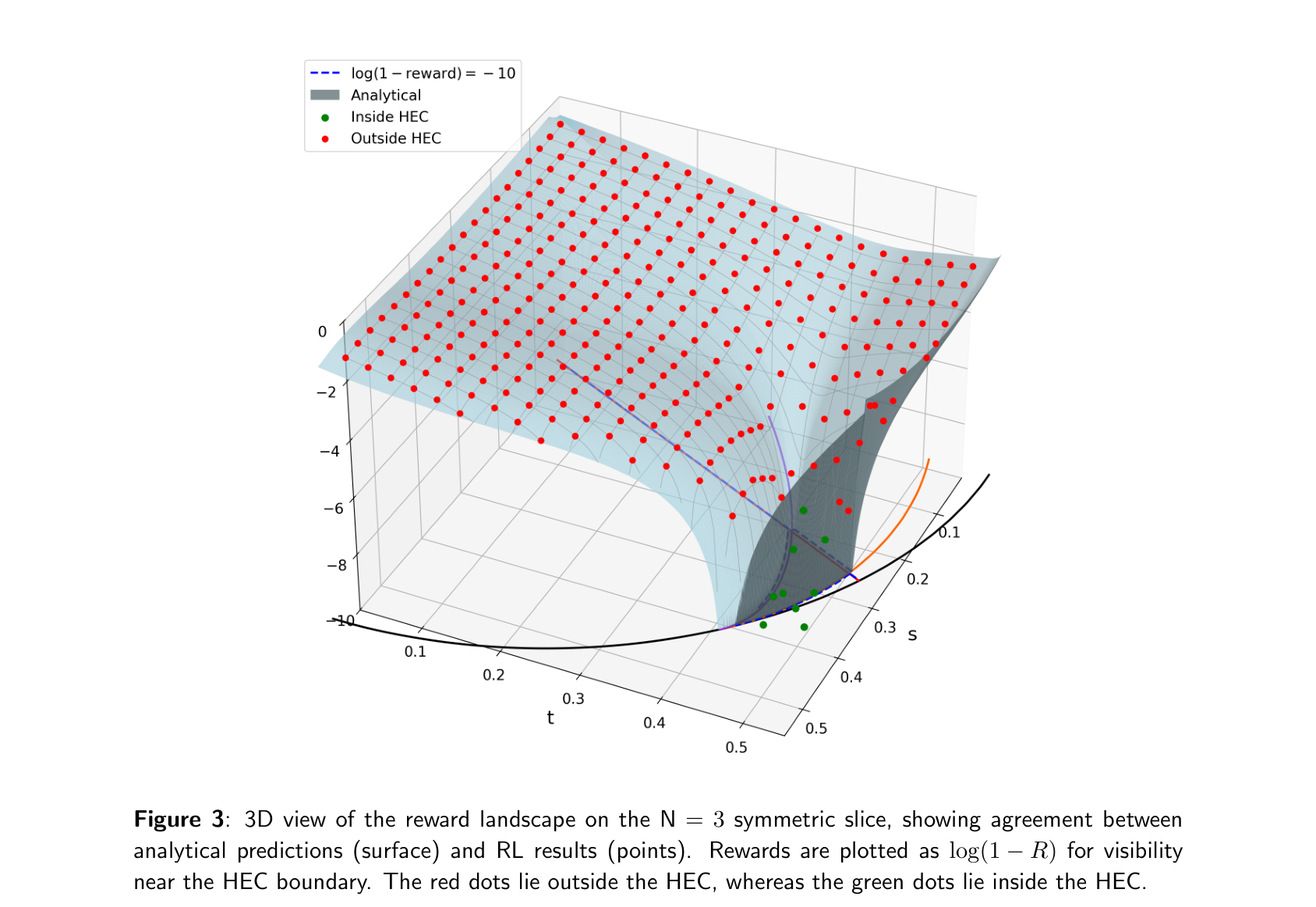
- N=3 validation: the algorithm rediscovers monogamy of mutual information (MMI) starting from a target vector outside the cone, and its reward landscape matches analytical predictions with correlation 0.996.
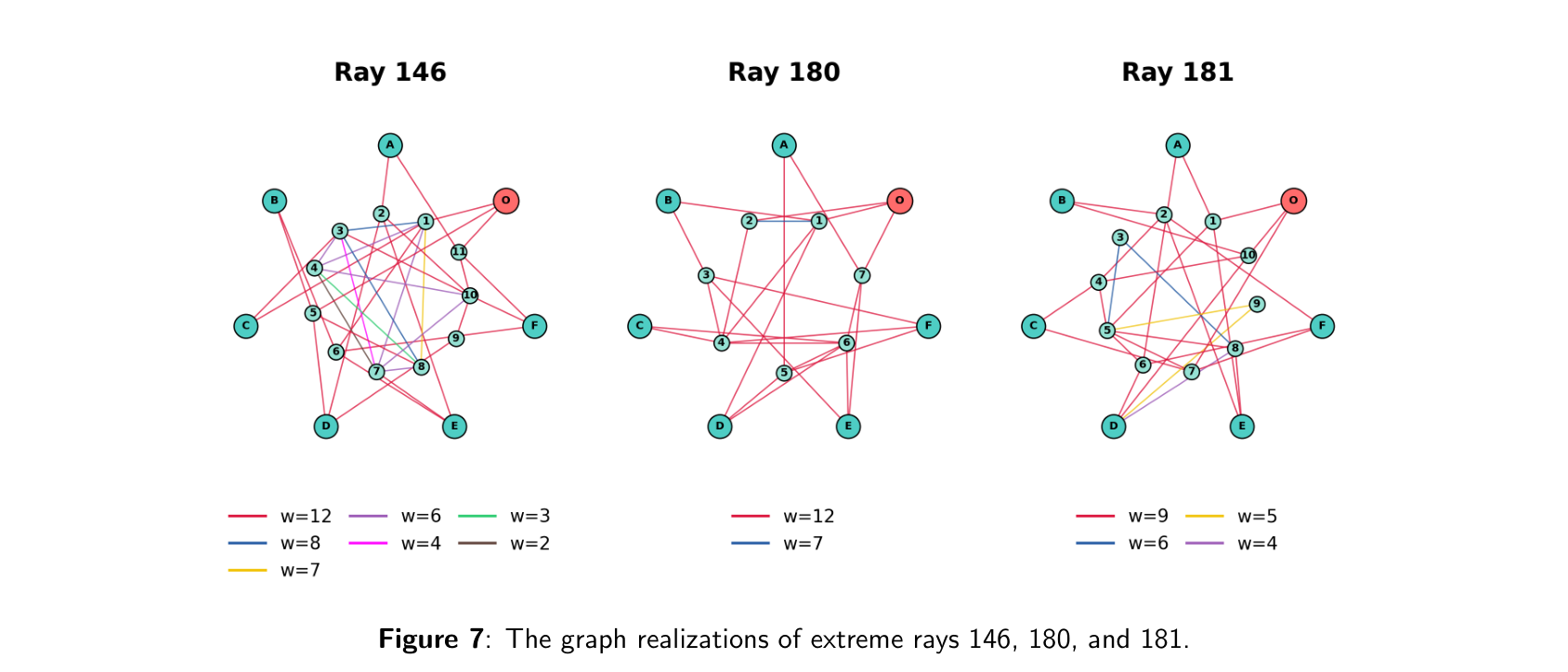
- N=6 mystery rays: we analyzed the six extreme rays of the subadditivity cone (from arXiv:2412.15364) that satisfy all known holographic entropy inequalities yet lacked graph realizations. Our algorithm found realizations for three of them, proving they are genuine extreme rays of the HEC.
- Unknown inequalities exist: for the remaining three rays we provide evidence that no realization exists — implying there are holographic entropy inequalities for N=6 that have not yet been discovered.
Companion tooling
Alongside the RL approach, I built lp_ray_finder, an LP-based active-set algorithm for finding extreme rays of convex cones at scales where standard vertex enumeration becomes infeasible (the N=6 system), with CPU-parallel and GPU-accelerated phases.
Code: EntropyCone_RL
This project is part of a broader theme I care deeply about: using modern ML not as a curve-fitter but as a search engine over mathematical structures — here, literally mapping the boundary of what quantum gravity allows.