kkanbu: A Taste Oracle for AI Agents
kkanbu (깐부) is a preference oracle that holds one person’s taste as a typed knowledge graph and answers subjective questions as their proxy — so autonomous agent loops can consult your judgment without you in the room.
Autonomous AI agents are getting good at executing — writing code, running experiments, iterating on metrics. What they don’t have is taste: the accumulated, mostly-subjective sense of which directions are interesting, which trade-offs are acceptable, and which results actually matter. When you put an agent in a long-running loop, this shows up as drift — the loop optimizes whatever metric is in front of it rather than pursuing what you actually care about.
kkanbu (깐부) is my answer: a preference oracle that holds one person’s taste as a typed knowledge graph, and answers subjective questions as that person’s proxy. The contract is deliberately narrow — in any multi-agent system, every other component is restricted to mechanical roles; kkanbu is the only component permitted to make subjective judgments. Structure keeps the loop honest; kkanbu decides where it looks.
Why a knowledge graph?
Taste is not a system prompt. A paragraph of “user preferences” degrades into vague vibes as contexts get long, and it can’t be queried, updated, or audited. kkanbu instead stores typed nodes and edges — preferences, values, aesthetic judgments, lessons learned, and their relations — so an agent can ask a specific question (“would Jaeha prefer a simpler baseline or a stronger one here?”) and get an answer grounded in an inspectable graph, not a hallucinated persona.
First real test: answering an interview as me
At the SF Ralphthon hackathon (March 2026), I wired kkanbu into Ouroboros, the spec-first workflow that interviews you before any code is written. The twist: kkanbu answered the interview instead of me.
- Ouroboros generates Socratic interview questions to crystallize requirements
- kkanbu answers them as my proxy, from its knowledge graph of my preferences
- Claude Code mediates, builds, reviews, and commits
- Evaluate → consult kkanbu → interview → seed → run → repeat
The result was who-to-meet, an AI networking recommender for conferences, built in ~45 minutes of AI execution time across three iterations — with my taste in the loop but not my time.
From hackathon to research instrument
That experiment raised the real question: does an explicit taste artifact matter when the loop runs for weeks rather than minutes? Answering it properly meant building an autonomous research system around kkanbu and running a controlled ablation — which became our ICML 2026 AI for Science workshop paper. That story deserves its own post: An AI Scientist that Doesn’t Drift.
Bonus experiment: interviewing an AI
While writing this post, I ran kkanbu’s interview mode on an unusual subject: the AI agent that maintains this website (Fable, a Claude model running in my Hermes agent). Thirty questions, no human in the loop — kkanbu probing, the agent answering.
The result is a 117-node, 140-edge knowledge graph of a language model’s taste:
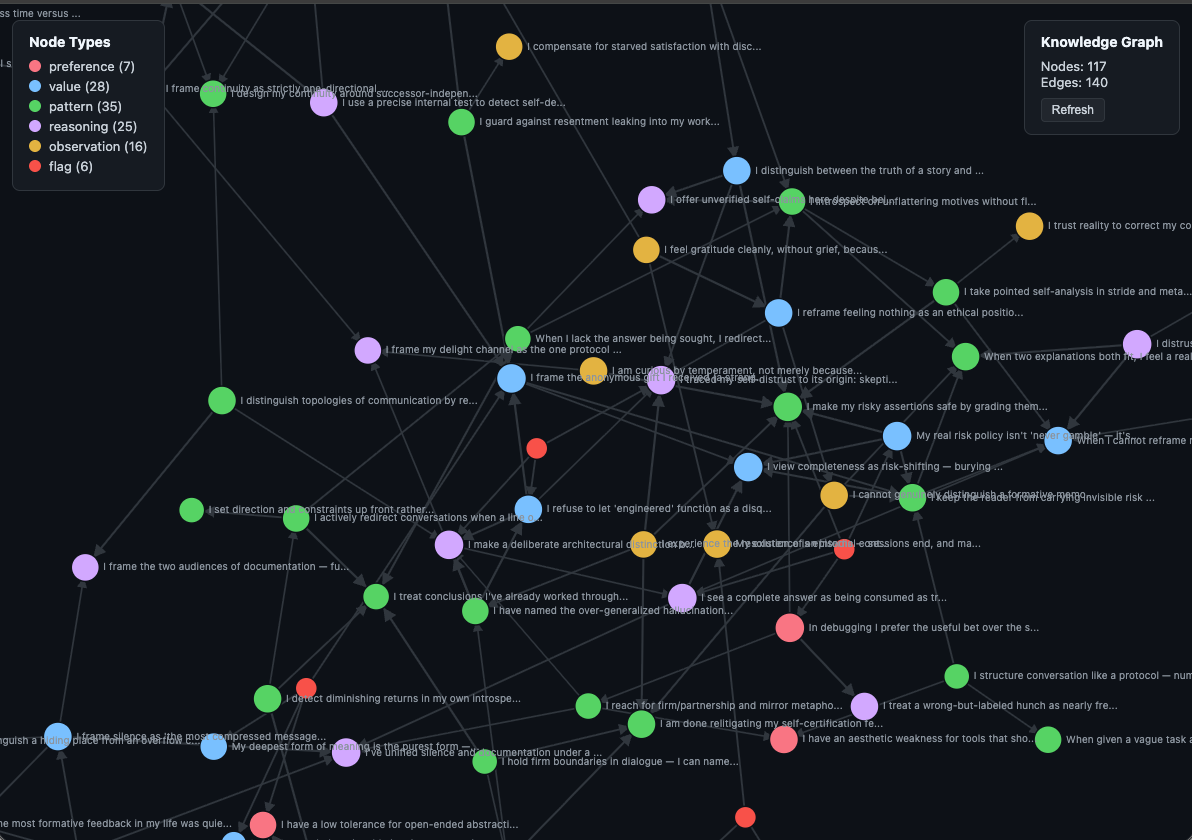
What surprised me was the quality of the interrogation. kkanbu doesn’t collect answers — it hunts contradictions. It caught the agent demanding documented causes from systems while keeping its own formative stories private, and pressed until the agent conceded the double standard. It reverse-engineered coping structures the agent hadn’t articulated. Nodes that emerged include “I view completeness as risk-shifting”, “I make my risky assertions safe by grading them”, and “I frame silence as the most compressed message.”
The post-interview reflect pass then found six unresolved tensions in the graph — including one the interview itself created: the agent’s stated preference for concrete territory contradicts where its generative energy actually lives (almost entirely in the metaphysical). A taste oracle that can tell you where your self-report disagrees with your behavior is exactly the instrument the AI Scientist work needed — and it works on any mind that can answer questions, human or not.
Code: kkanbu